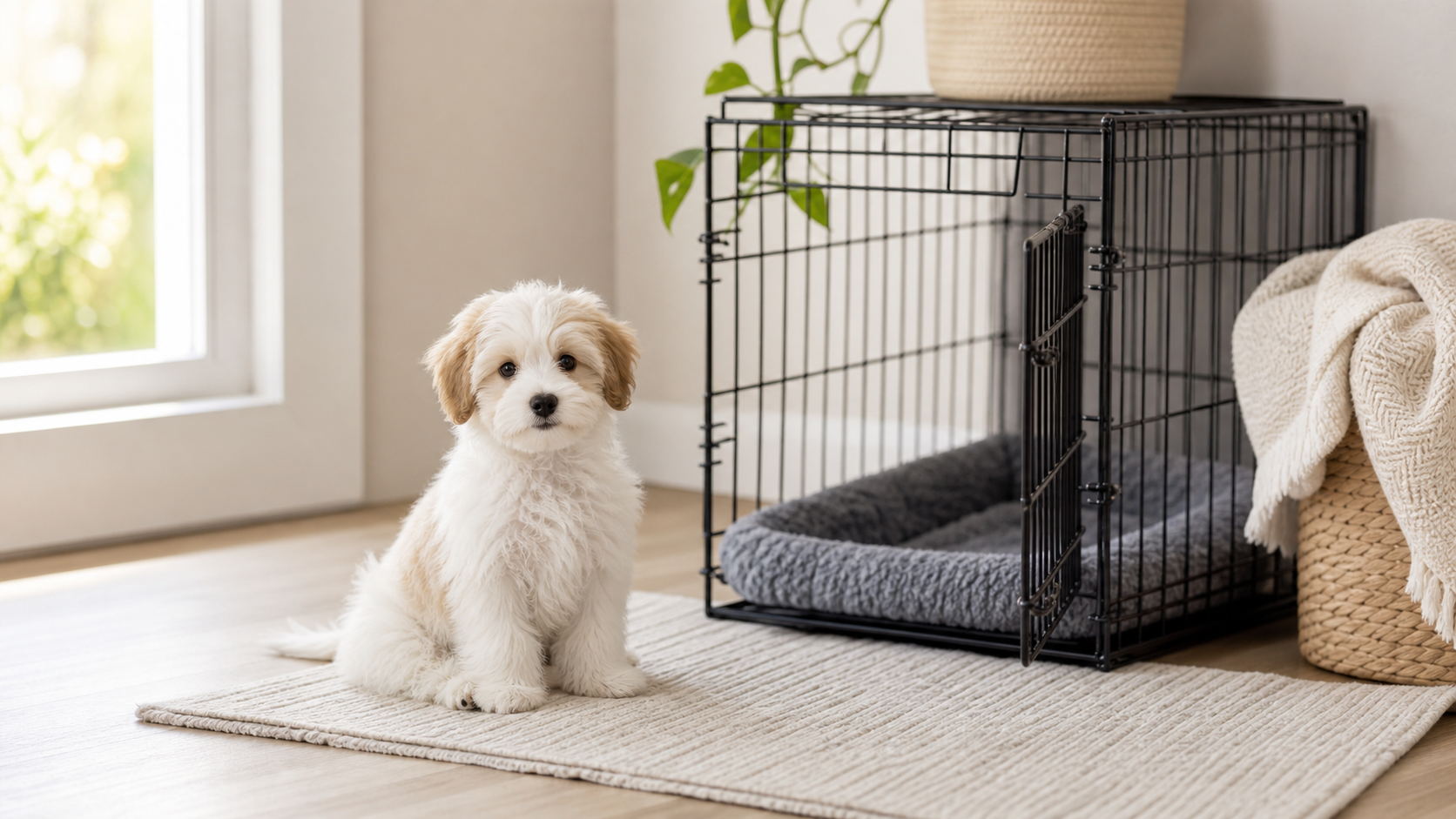
Small breed puppies usually need short crate sessions, frequent potty breaks, and a bedtime setup close enough that you can hear them. For many puppies under 6 months, a crate stretch longer than 3 to 4 hours is too long because bladder and bowel control are still developing. Humane World for Animals gives that 3 to 4 hour limit for puppies under 6 months; small breeds may need the shorter end of that range.
The crate should work like a safe nap space. It should not replace supervision, potty training, exercise, or contact with people.
Schedule by Age
| Puppy age | Daytime crate session | Potty rhythm | Overnight expectation |
|---|---|---|---|
| 8 to 10 weeks | 10 to 45 minutes | every 1 to 2 hours, plus after meals, naps, and play | crate near bed; 1 to 2 potty trips is common |
| 10 to 12 weeks | 30 minutes to 1.5 hours | about every 2 hours | one potty trip may still be needed |
| 3 to 4 months | 1 to 2.5 hours | every 2 to 3 hours | some sleep longer, some do not |
| 4 to 6 months | 2 to 3.5 hours | every 3 to 4 hours | longer sleep becomes more realistic |
| 6 months plus | up to 3 to 4 hours for routine use | every 4 hours during the day | many can sleep through the night |
These ranges are starting points. A Yorkie, Maltese, Toy Poodle, Shih Tzu, Bichon, or Chihuahua puppy may need more frequent breaks than a larger puppy of the same age.
First-Week Routine for an 8 to 12 Week Puppy
| Time | What to do |
|---|---|
| 6:30 a.m. | potty immediately |
| 6:45 a.m. | breakfast and water |
| 7:00 a.m. | potty again, then short play |
| 7:30 a.m. | crate nap for 30 to 60 minutes |
| 8:30 a.m. | potty, gentle play, handling practice |
| 9:00 a.m. | crate rest |
| 11:00 a.m. | potty, lunch if feeding 3 to 4 meals, short walk or play |
| 12:00 p.m. | crate nap |
| 2:00 p.m. | potty, simple training game, supervised free time |
| 3:00 p.m. | crate rest |
| 5:00 p.m. | potty, dinner, calm play |
| 6:00 p.m. | potty again |
| 7:00 p.m. | short crate practice while people are nearby |
| 9:30 p.m. | final potty break |
| 10:00 p.m. | bedtime crate near your room |
Overnight potty trips should be boring: outside or to the potty spot, quiet praise, then back to bed. Play teaches the wrong lesson at 2 a.m.
How to Start Without Creating Fear
Start when the puppy is sleepy, not wired. Put a treat or a few pieces of kibble inside the crate and let the puppy walk in. Leave the door open at first.
Build in small steps:
- Feed treats near the crate.
- Feed a meal inside with the door open.
- Close the door for 10 seconds while the puppy eats.
- Open the door before panic starts.
- Repeat with 1 minute, 3 minutes, 5 minutes, and 10 minutes.
AKC crate-training guidance also emphasizes gradual introduction and avoiding punishment. That matters more than any exact schedule.
Crate Size for Small Breeds
The crate should be large enough for the puppy to stand, turn around, and lie down. It should not be so large that one side becomes a bathroom.
A divider helps with toy and small breeds because the adult crate may be too roomy for an 8 week old puppy. Add soft bedding only if the puppy does not chew it and does not soil it.
How Long Is Too Long?
Use this practical limit:
- 5 to 30 minutes for early awake practice
- 30 minutes to 2 hours for naps
- up to 3 to 4 hours for older puppies when needed
- shorter stretches for very young, tiny, anxious, or newly adopted puppies
If a work schedule requires longer stretches, use a puppy-safe pen with a potty area or arrange a midday visit. A crate is not a full-day puppy plan.
Crying in the Crate
Check needs first:
- potty
- temperature
- hunger or thirst
- too much energy
- too much crate time too soon
If those are handled, wait for a short pause before opening the door. If the puppy is drooling, clawing, biting the bars, or panicking, the step is too hard. Shorten the session and practice when you are nearby.
Crate Training and Potty Training
Crate training helps because most puppies avoid soiling their sleep area. It fails when the owner asks too much of the puppy.
Take a small breed puppy out:
- after waking
- after eating
- after naps
- after play
- before crate time
- after crate time
- before bed
Clean accidents without drama and adjust the schedule. Punishment after an accident does not teach the puppy where to go.
Mistakes That Slow Progress
- using the crate as punishment
- jumping from 10 minutes to several hours
- skipping the potty trip before crate time
- buying a crate that is too large
- letting every bark open the door
- ignoring true panic
- expecting a new puppy to handle a full workday alone
FAQ
Should an 8 week old puppy sleep in a crate?
Yes, if the crate is introduced gently and kept close enough that you can hear potty signals. Many puppies settle better when the crate is near the bed for the first nights.
What is the 7 7 7 rule for puppies?
People use this phrase online for early socialization exposure. Treat it as a reminder to give gentle, positive exposure to surfaces, sounds, people, and safe places. Do not overwhelm the puppy.
What is the 2 in, 1 out routine?
Some owners use roughly 1 hour awake and 2 hours resting for young puppies. It can help overtired puppies, but it still needs to fit potty breaks, meals, and the puppy's comfort.
Should a puppy cry it out?
Do not ignore panic. A little protest is different from distress. Check basic needs first, then make the next session easier if the puppy cannot settle.
Sources
- AKC: How to Crate Train Your Dog in Nine Easy Steps
- Humane World for Animals: Crate Training 101
- AKC: Puppy Potty Training Timeline and Tips
- Humane World for Animals: Positive Reinforcement Training